
Why Movement Reset Comes Before Posture Correction
Many expats and international residents used to enjoy squats, deadlifts, and weight training before life became busier. Pregnancy, childbirth, childcare, adapting to life in Korea, and demanding schedules can all make it difficult to stay consistent with exercise.
If you want to start exercising again in Seoul but feel unsure where to begin, you are not alone.
When you finally decide to return to the gym, your body may feel different from before. Your lower back may feel tight. Your pelvis or hips may feel less stable. Your shoulders and neck may feel stiff. You may also worry about starting again and feeling discomfort or pain.
Some people are new to strength training and have never properly learned how to exercise. The gym can feel unfamiliar when you do not know which exercises to start with, how to use the machines, or how to check your own form.
In both cases, what you need first is not an intense workout.
What you need first is to understand where your body is now and rebuild your basic movement patterns.
At REFINE SEOUL, we see this not simply as “posture correction,” but as a Movement Reset.
Posture correction often sounds like fixing the way your body looks. A Movement Reset is different. It focuses on how your body is supported, how you breathe, and how you move into strength exercises.
Good posture is not about forcing yourself to stand perfectly straight all day. It is about finding a position where your body feels supported, breathing feels natural, and movement can happen more easily.
Why basic movement comes first
Strength training is connected to everyday movement.
A squat is connected to sitting down and standing up.
A deadlift or hip hinge is connected to picking something up from the floor by folding and extending through the hips.
A lunge or step-up is connected to supporting your body on one leg and shifting your weight with control.
A press or row is not just an arm exercise. It is a pushing or pulling movement built on a stable spine, ribcage, and pelvis.
That is why people who are returning to exercise — or learning strength training for the first time — benefit from checking their basic movement patterns first.
This does not make exercise more complicated.
It gives you a safer, clearer, and more confident starting point.
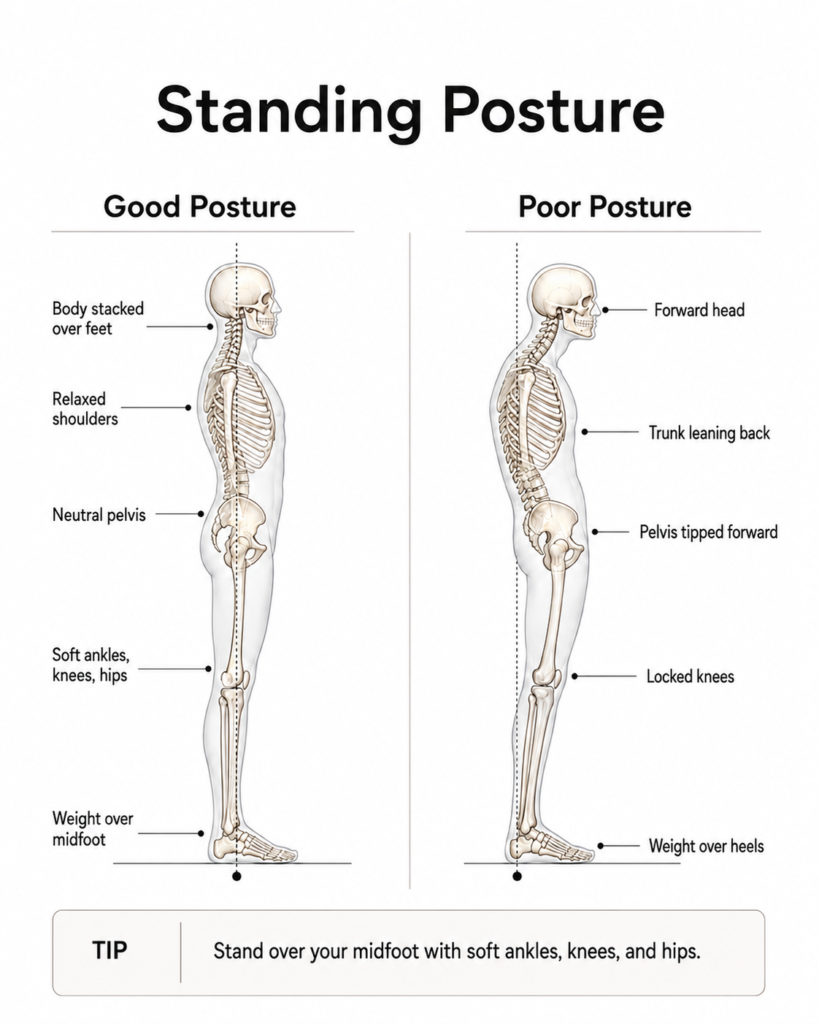
1. Standing: Find your body’s baseline
Good standing posture is not about holding your body stiff and upright.
It is about feeling the floor through your whole foot, without letting your weight collapse too much to one side. Your feet, knees, pelvis, spine, and head should feel comfortably connected.
Check these points.
- Feel the floor through your whole foot.
- Do not lock your knees or pelvis too aggressively.
- Keep your ribcage and pelvis from drifting too far apart.
- Relax your shoulders and neck, and breathe naturally.
Good standing gives you a baseline for squats, deadlifts, presses, and many other strength exercises.
2. Walking: Shift your weight naturally
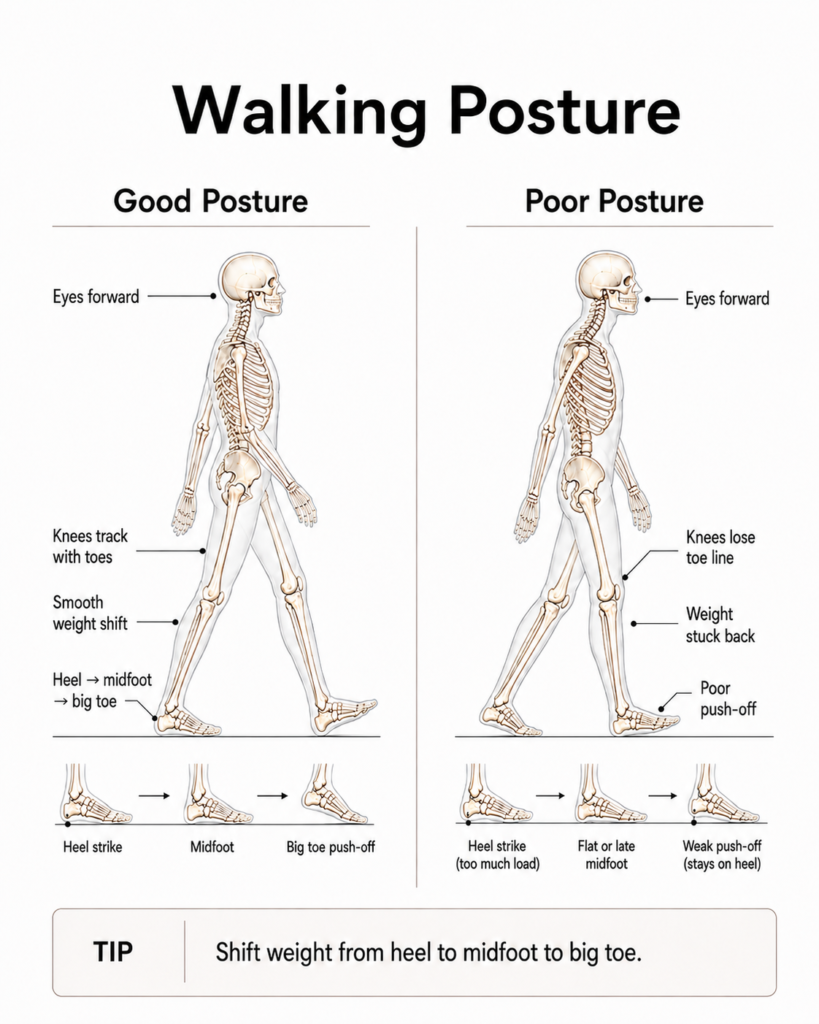
Good walking is not about taking the biggest steps possible.
What matters is how naturally your weight moves from one foot to the other. Walking is a basic movement pattern that connects your feet, knees, pelvis, and spine.
If you have difficulty supporting your body on one leg, exercises like lunges, step-ups, and single-leg movements may place unnecessary stress on your knees or hips.
Check these points.
- Walk with a comfortable stride.
- Do not let your weight stay only in your heels.
- Let your weight move through the middle of the foot and forward naturally.
- Notice whether your body sways too much from side to side.
Good walking helps you build a better foundation for lower-body strength training.
3. Sitting: Support your body instead of hanging on your lower back
Many people spend long hours sitting while driving, working on a laptop, taking care of children, or waiting during daily routines.
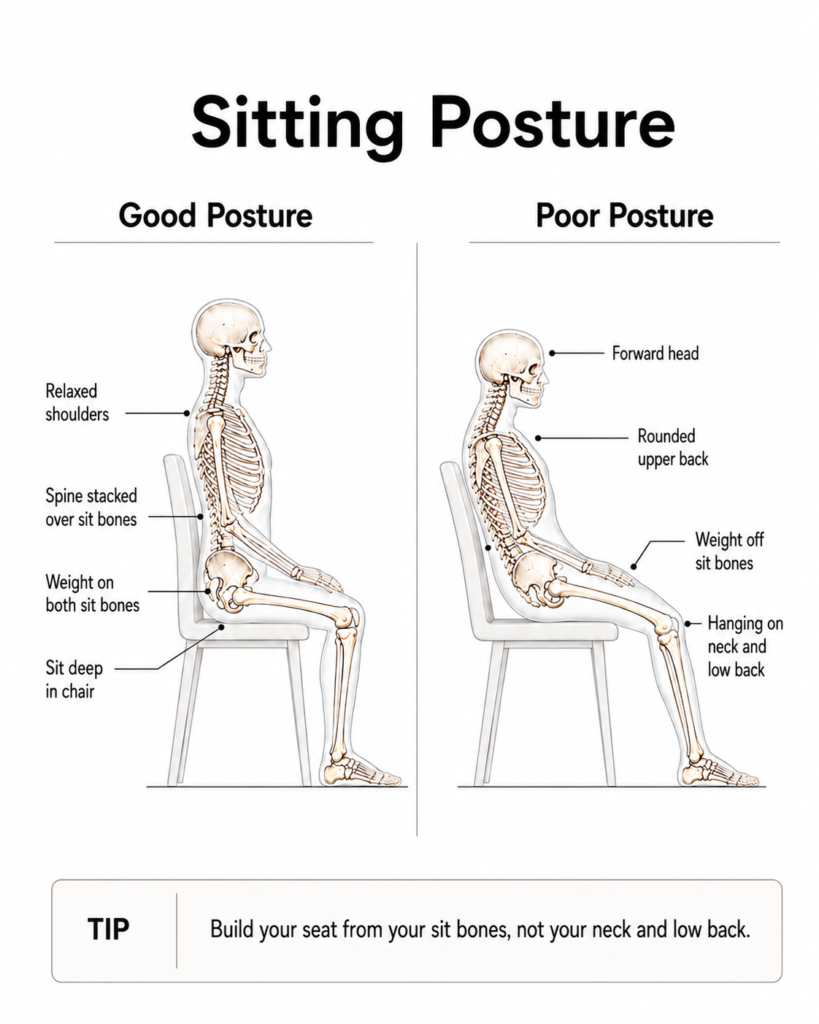
Good sitting is not about holding your lower back tightly. It is about placing your weight on both sit bones and allowing your spine and head to stack comfortably over your pelvis.
The way you sit is also connected to the way you squat. A squat is not just bending your knees. It is the ability to feel the floor, use your hips and knees together, and keep your torso supported while sitting down and standing up.
Check these points.
- Place your weight on both sit bones.
- Let your spine and head stack comfortably over your pelvis.
- Do not arch only your lower back into the chair.
- If you sit for a long time, change position regularly.
Good sitting is an important foundation for learning squats, hip hinges, and core exercises.
The goal the right starting point.
REFINE SEOUL does not force one perfect posture on everyone.
Your exercise history, childbirth experience, pain history, lifestyle, and current fitness level all matter.
If you have taken a long break from exercise, you do not need to return immediately to the way you trained before. If you are new to strength training, you do not need to copy someone else’s routine.
First, understand your body.
Then, rebuild your basic movements.
After that, progress into strength training.
REFINE SEOUL helps expats and international residents in Seoul learn strength training in English with clear communication and personalized guidance.
The first step is not a hard workout plan.
The first step is a Body Review.
During a Body Review, we look at your current body condition, exercise history, lifestyle, discomfort or pain points, and goals. Then we check basic posture and movement patterns such as standing, walking, sitting, squatting, hip hinging, pushing, and pulling.
If you want to start strength training in Seoul with clear English communication, start by understanding your current body and movement patterns.
Start with a Body Review.
Find your starting point, rebuild your foundation, and return to strength with confidence.
Note: If you have severe pain, numbness, sensory changes, an acute injury, or are recovering from surgery, please consult a medical professional before starting exercise.